
how-to
How Do You Choose a Hands-On Culinary Experience for Adults?
Last Updated: October 25, 2026
Quick Summary
A hands-on culinary experience transforms how you cook at home by teaching you directly from a professional chef who guides you through real techniques, explains the reasoning behind each step, and builds your confidence through learning by doing rather than watching.
- Choose between group classes for social energy or private classes for personalized pacing and technique focus.
- Identify your skill level (Foundation, Building, or Refining) and ask instructors what specific skills you'll demonstrate unaided after the class.
- Clear counter space, accessible equipment, working appliances, and good lighting prepare your kitchen for instruction.
- Communicate dietary needs, allergies, and accessibility considerations before booking so the instructor can adapt the menu and techniques.
- Compare quotes by dividing total cost by guest count and instructional hours, and confirm whether ingredients, travel, and cleanup are included.
Table of Contents
- What Makes a Hands-On Culinary Experience Worth Your Time
- What to Learn in Cooking Classes Before You Book
- Assessing Your Skill Level: Are Cooking Classes for Beginners Right for You?
- Private Cooking Classes vs. Group Experiences: What Fits Your Needs
- Professional Cooking Techniques at Home: What to Expect and How to Prepare
- Practical Preparation Steps Before Your Class Arrives
- Booking Your Private Chef-Led Culinary Class
- Frequently Asked Questions
What Makes a Hands-On Culinary Experience Worth Your Time
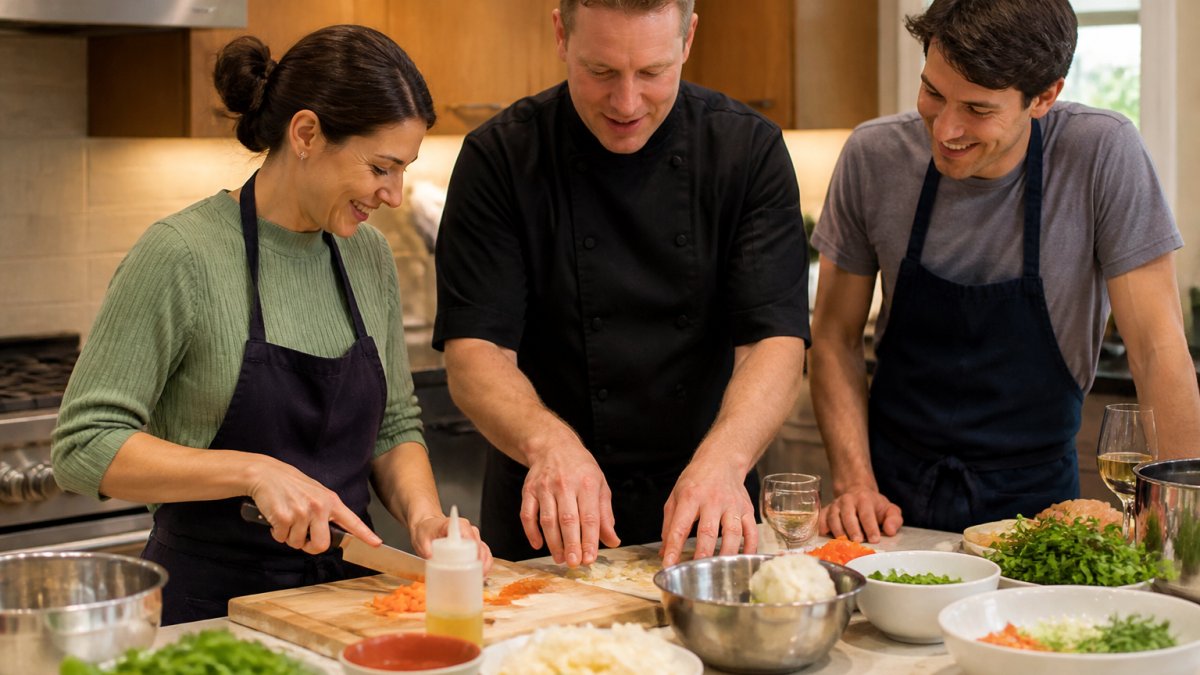
A hands-on culinary experience transforms how you cook at home. Instead of following recipes alone, you learn directly from a professional chef who guides you through real techniques, explains the why behind each step, and builds your confidence.
Unlike a cooking video, your hands are moving, your palate is learning, and you're creating something you'll actually eat, so the skills stick.
What makes it worth your time: professional instruction tailored to your level, a setting where mistakes are comfortable, and techniques you'll use repeatedly.
Consider what you want from this investment: an educational date night, restaurant-quality meals at home, or genuine skill-building? Your answer shapes which experience makes sense. Every Cooking Class is a night to remember. See the specific culinary experiences available to understand what's worth your time.
What to Learn in Cooking Classes Before You Book
Not every cooking class teaches what you need. Some favor entertainment over skill; others assume knowledge you don't have.
The most valuable professional cooking techniques at home fall into a few categories.
Beyond individual techniques, the best experiences teach the mindset of professional cooking: how chefs plan workflow, think about ingredients, and recover when something goes wrong.
Ask potential instructors what specific skills you'll walk away with.
Assessing Your Skill Level: Are Cooking Classes for Beginners Right for You?
If you can boil water and follow basic instructions, you're ready for a hands-on culinary experience designed for beginners. The question isn't whether you're "good enough" but whether the class meets you where you are and offers a clear path forward.
Most listings stop at "beginner-friendly", a label that tells you almost nothing. Map your comfort level to specific, observable skills, then check that the class teaches toward the next level.
A Practical Skill-Level Map
Use this three-tier framework to place yourself honestly before you book. It is a common pattern among instructors who teach adults, not a formal certification.
- Foundation (true beginner): You can follow a recipe and use a stove safely, but you're not confident with a chef's knife, you season by guesswork, and you rely on timers rather than sight and sound. Your goal is repeatable basics.
- Building (confident home cook): You cook several times a week and can improvise a simple meal, but you still struggle with heat control on proteins, sauce consistency, or timing a multi-dish meal. Your goal is technique you can transfer across recipes.
- Refining (experienced home cook): You're comfortable with most techniques and want to sharpen execution, learn a specific cuisine properly, or develop plating. Your goal is precision and polish.
Be honest about which tier you occupy for the specific skill you want to learn. Someone can be "Building" overall but "Foundation" on pastry, or the reverse. Tell the instructor which tier applies to the technique you care about.
What Each Level Should Actually Walk Away With
A class worth your money produces a skill you can demonstrate afterward, not just a meal you ate. Ask what you'll be able to do unaided when it ends. Concrete answers sound like this:
- Foundation outcomes: hold and guide a chef's knife with a consistent grip and safe cutting motion; dice an onion evenly; know the visual and auditory cues for a properly heated pan; season to taste in stages rather than all at once.
- Building outcomes: control heat to sear a protein without overcooking it; build a pan sauce from fond and deglaze correctly; balance salt, acid, fat, and heat deliberately; time two or three components to finish together.
- Refining outcomes: execute a specific cuisine's core techniques (for example, laminated dough, fresh pasta shaping, or stock clarification); plate for presentation; adapt a technique to new ingredients rather than following one recipe.
If an instructor cannot name outcomes at this level of specificity, treat that as a signal.
How to Verify the Fit Before You Book
A short conversation closes the gap between listing and reality. Ask three questions: What will I be able to do on my own afterward? How much of the class is me doing the work versus watching?
Good answers describe pacing and checkpoints, not just enthusiasm. A well-run class builds in moments where the instructor watches your hands and corrects in the moment, with a fallback if a technique isn't landing.
Finally, plan how you'll practice. Skills fade without repetition. Decide in advance which two or three techniques you'll cook again within a week, and keep the instructor's notes or your own cues visible. Progress comes from deliberate repetition, not a single evening.
Private Cooking Classes vs. Group Experiences: What Fits Your Needs
Group cooking classes create energy and social connection.
Private cooking classes are fundamentally different. The instructor adjusts pacing to your learning style.
For couples or small groups of friends, private experiences create intimacy group classes can't match.
Consider your goals. To master a specific technique at your own pace, private is superior.
Each format offers distinct advantages depending on what you want from the experience.
| Format | Best For | Key Difference |
|---|---|---|
| Group cooking classes | Social energy and learning from others | Instructor cannot pace to your individual speed |
| Private cooking classes | Mastering specific techniques at your own pace | Instructor adjusts pacing to your learning style |
| Private for couples or small groups | Intimate special occasion | Less performance pressure, personalized experience |
Professional Cooking Techniques at Home: What to Expect and How to Prepare
Professional cooking techniques are learnable. You don't need years of training, just clear instruction and deliberate practice.
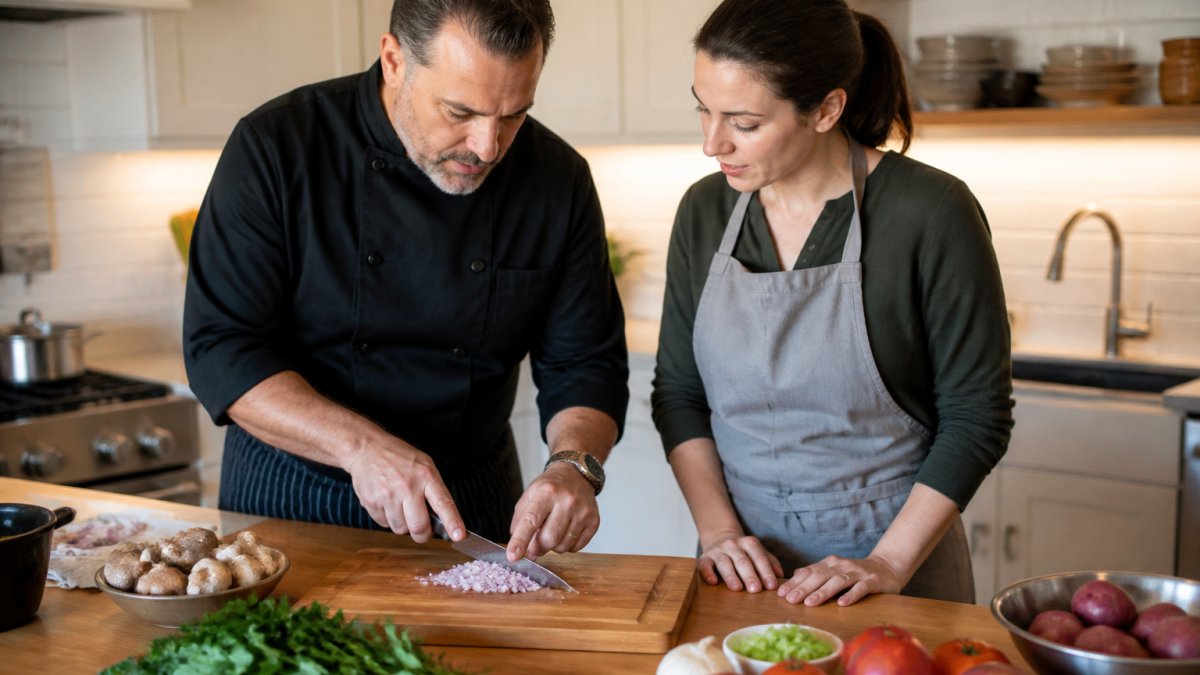
Expect to learn by doing, not listening. A professional instructor demonstrates a technique, explains the reasoning, then guides you through it step by step.
The instructor watches your hand position, timing, and confidence, offering corrections in the moment so you build correct habits from the start.
Preparation before the class matters more than you'd think.
Practical Preparation Steps Before Your Class Arrives
Kitchen Space and Equipment Readiness
Your kitchen doesn't need to be large or fancy, just organized enough that you and the instructor can work comfortably.
Check that your essential equipment is accessible. A sharp chef's knife or two. A cutting board that won't slip. Mixing bowls.
Your stove and oven should be in working order.
Lighting matters more than most people realize. If your kitchen is dim, turn on additional lights or move the class to a better-lit area.
Dietary Needs, Allergies, and Accessibility Considerations
Professional instructors plan menus around dietary needs and allergies. This isn't an inconvenience, it's part of the job. Before your class, communicate clearly about any restrictions or preferences.
The instructor will either adapt the planned menu or suggest an alternative that works for your group, so the class proceeds with food you can actually eat and enjoy.
Accessibility goes beyond dietary and physical needs. If you're learning English as a second language, let your instructor know.
Booking Your Private Chef-Led Culinary Class
When you're ready to book, you're deciding how you'll spend an evening and what you'll take away from it. That deserves the same thoughtfulness you'd give any meaningful experience, including understanding what you're actually paying for.
What Drives the Cost of a Private Class
Private chef-led classes are priced per experience rather than per seat, so the cost is shaped by a handful of variables. Knowing them lets you compare quotes fairly instead of comparing headline numbers that include different things.
- Group size: A flat rate spread across two guests costs far more per person than the same rate split across eight. Per-person value improves as the group grows, up to the point where attention is diluted.
- Menu complexity and ingredients: Dishes built on premium proteins, specialty produce, or imported pantry items cost more than a vegetable-forward or staple-based menu. Ask whether the quote is ingredient-inclusive.
- Duration and number of dishes: A two-hour, two-dish class and a four-hour, multi-course class are different products. Confirm the length and dish count in writing.
Because rates vary by instructor, region, and menu, treat any single figure as a starting point for a conversation, not a benchmark. Ask for a written quote that separates the base experience from every add-on, then divide by the number of guests to see the true per-person figure.
What a Quote Should Itemize
A transparent quote answers these questions before you commit:
- Are all ingredients included, or is there a separate grocery charge?
- Is prep and cleanup included, or is there a setup or reset fee?
- Is travel included, and within what radius?
If any of these are missing, ask. A professional instructor would rather clarify upfront than surprise you later. Comparing two quotes is only meaningful when both itemize the same categories.
Comparing Value Across Formats
Per-person cost is not the same as value. A group class may have a lower per-person price but less individual attention and a fixed menu. A private class costs more per person at small group sizes but adapts pacing, menu, and technique focus to you.
A simple way to compare: divide the total quote by the number of guests, then divide again by the hours of hands-on instruction. That gives you a rough cost per person per instructional hour.
Confirm the Logistics in Writing
Once the quote is clear, lock down the practical details in writing: date, start time, duration, guest count, menu, and the dietary and accessibility notes you shared.
Let's plan your perfect evening. Tell us about your group, preferred date, and what you'd like to cook. Private in-home cooking classes, we'll handle everything else.
When you book with Mise en Your Place, you're not just booking a class. You focus entirely on learning, cooking, and enjoying the meal together. From your first message to your last bite. Here's exactly how it works, from your first message to the last bite.
The hands-on culinary experience you choose should feel like an investment in yourself and your loved ones, not a transaction.
Frequently Asked Questions
What skills can you realistically learn in a hands-on culinary experience?
A hands-on culinary experience teaches practical kitchen skills: knife techniques, sauce preparation, food safety, flavor balancing, and plating presentation. You'll master techniques specific to the cuisine, whether Thai-inspired sauces, Spanish tapas preparation, or French classical methods. Unlike passive cooking shows, you practice each step under chef guidance, building muscle memory and confidence you can apply immediately in your own kitchen.
Do you need cooking experience to take cooking classes for beginners?
No. Beginner-focused cooking classes assume no prior experience and start with foundational techniques. A professional chef adjusts pacing and explanation to your skill level, whether you can barely make pasta or have some kitchen confidence. The chef's role is to guide, not judge, they design the class so you learn at your pace while building real culinary skills and confidence.
How much does a private hands-on culinary experience typically cost?
Pricing depends on several factors: class duration, number of participants, menu complexity, cuisine type, and whether the chef handles all preparation and cleanup. Costs vary significantly based on your preferences and group size. Contact Mise en Your Place directly for a custom quote tailored to your needs, dates, and kitchen setup.
What's the difference between private cooking classes and group cooking classes?
Private cooking classes are tailored to your kitchen, preferences, and skill level with personalized pacing and menu selection. Group classes follow a set curriculum with fixed menus and timing. Private classes offer flexibility for dietary needs, allergies, and accessibility; group classes provide a social experience with other participants. Private formats work best for couples, families, or those wanting professional techniques at home without the group dynamic.

Ready to cook something memorable?
Chef Chris brings the full restaurant experience into your home — every detail handled, every dish made together.