
how-to
Private Chef Home Cooking Class Cost: What You Pay For
Table of Contents
- Private Chef Home Cooking Class Cost: What Actually Drives the Price
- Why an In-Home Class Costs More Than a Group Studio Class
- In-Home Cooking Class Pricing: Flat Fee, Per-Person, or Hourly?
- What's Included in a Private Cooking Class (and What Costs Extra)
- Private Chef Cooking Class Duration: How Long You're Actually Booking
- Cooking Class for Couples at Home: Is the Date Night Premium Worth It?
- How to Compare Quotes and Budget for Your Class
- Conclusion: Getting Real Value From Your Private Cooking Class Cost
- Frequently Asked Questions
Last Updated: October 8, 2026
Private Chef Home Cooking Class Cost: What Actually Drives the Price
The private chef home cooking class cost rarely comes down to a single number: you're paying for a chef's time, the ingredients, and the convenience of cooking in your own kitchen.
A studio class bundles dozens of people into one room and spreads the overhead across all of them.
Below, we break down what moves the number, how the pricing models compare, and how to read a quote.
Why an In-Home Class Costs More Than a Group Studio Class
An in-home cooking class costs more than a group studio class because the chef's full attention, travel, setup, and cleanup are dedicated to your group instead of shared across a room of strangers.
In a studio class, rent, utilities, insurance, and the instructor's rate get divided by twenty or thirty guests.
There's also the invisible labor. In a studio, the kitchen is already stocked.
In-Home Cooking Class Pricing: Flat Fee, Per-Person, or Hourly?
In-home cooking class pricing usually follows one of three models: a flat fee, a per-person rate, or an hourly charge. Most private chefs blend them, using a base fee plus a per-person component once your group passes a certain size. Compare formats on the same footing:
| Pricing Model | How It Works | Best For | Watch Out For |
|---|---|---|---|
| Flat fee | One price for the whole session | Small, fixed groups | Higher cost if your group is tiny |
| Per-person | Rate multiplied by headcount | Larger groups | Adds up fast as guests increase |
| Hourly | Charged by time on site | Flexible, open-ended events | Longer sessions inflate the total |
| Base + per-person | Flat base plus a per-head add-on | Most private bookings | Confirm where the base ends |
The base-plus-per-person model is most common: it guarantees the chef a minimum for showing up, then scales as your guest list grows.
Cost Comparison by Class Format
The three formats buyers choose between are hourly private lessons, per-person group classes, and event-style cooking experiences. They are not interchangeable, and the same menu can land at very different totals.
- Hourly private lesson. You pay for the chef's time on site. This suits one or two people who want technique instruction, knife skills, sauces, pastry, rather than a full meal. The per-person average stays high because few people share the time.
- Per-person group class. The rate is multiplied by headcount, often with a minimum. This is the most predictable format for six or more guests because fixed costs spread across more people. The per-person rate does not fall indefinitely, most chefs stop discounting once the group needs a second set of hands.
- Event-style cooking experience. A flat or base-plus-per-person fee covers a full meal with instruction woven through it, most often booked for birthdays, anniversaries, and team events. Premium proteins, multiple courses, and longer service windows push the total above a straightforward lesson.
The hourly lesson often looks cheapest on a booking page and the event-style experience most expensive, but once you divide by headcount and add ingredients, the ranking often flips.
How Group Size Changes Your Total
Group size is the single biggest lever on your total. A couple pays the full base fee between two people, so the per-person average is high. A group of ten divides that same base across ten, dropping the per-person average even though the total is higher.
This is why minimum group sizes and minimum spends exist: below a certain headcount, the chef can't cover time and ingredients.
What Actually Drives the Final Bill
Beyond the pricing model, five line items move the total more than anything else. Knowing them lets you predict a quote before you request one.
- Chef labor. The largest component: time on site plus prep and reset, scaling with experience and specialization.
- Ingredients. Usually second-largest. Menu complexity, premium proteins, and specialty pantry items drive this up; a simpler seasonal menu drives it down.
- Travel. A per-kilometre or flat fee is common for in-home service, especially outside a chef's core area. Confirm whether it is included.
- Taxes and gratuity. These sit on top of the quoted subtotal and are the most common reason a final bill exceeds budget. Ask whether the quote is tax-inclusive and whether gratuity is expected.
- Equipment and setup. Specialty tools the chef brings, plus rentals or replacements, may be charged separately. Most chefs work with your kitchen's equipment, but a few bring their own.
What's Included in a Private Cooking Class (and What Costs Extra)
What's included in a private cooking class varies by provider, but most quotes cover instruction, ingredients, and cleanup. Travel, premium proteins, and specialty equipment are most often charged separately.
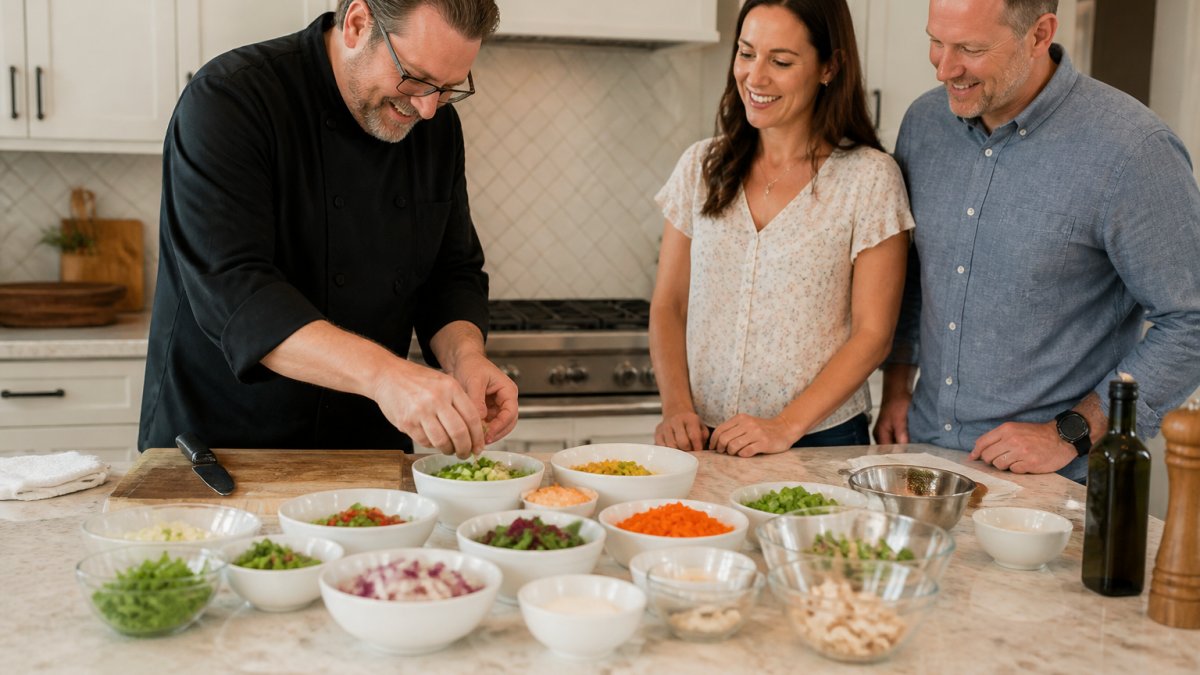
The fastest way to compare two quotes is to line up their inclusions side by side.
Inclusions to Confirm Before You Book
Run through this checklist before you commit to any quote:
- Does the fee include all ingredients, or is there a grocery charge?
- Is travel to your home included, or billed separately?
- Are dietary restrictions handled at no extra cost?
How Inclusions Change the Effective Per-Person Cost
Inclusions are line items that either sit inside the quote or get added later. To see their effect, normalize two quotes to the same session, group size, and inclusions, then divide by headcount.
Consider two quotes for the same eight-person class. Quote A has a higher headline rate but includes ingredients, travel, and cleanup. Quote B has a lower headline rate but charges separately for groceries, travel, and cleanup.
What Is Typically Included Versus Charged Extra
Most private chefs include the following in the base fee:
- Chef instruction and hands-on guidance
- Standard ingredients for the agreed menu
- Basic equipment already in your kitchen
Items most often charged separately:
- Premium proteins such as beef tenderloin, lamb, or fresh seafood
- Specialty pantry items or imported ingredients
- Travel outside the chef's core service area
A Quote Request Checklist
To get comparable quotes, give every provider the same information up front. A quote built on vague inputs is not comparable to one built on specifics.
Provide:
- Your location and whether parking or building access is easy
- Your preferred date and start time
- Your group size, including children
Ask each provider:
- Is the quote tax-inclusive, and is gratuity expected?
- What is the minimum booking, and is it a headcount or a dollar minimum?
- What is excluded from the quote?
Once every quote answers the same questions, divide each total by headcount. That per-person average is the only figure worth comparing, because it captures the base fee, per-head charge, extras, and taxes in one line.
Private Chef Cooking Class Duration: How Long You're Actually Booking
Private chef cooking class duration typically runs two to three hours of active instruction, though the full booking stretches longer once setup and cleanup are counted.
Ask the chef to break down the time. A typical session includes:
- Arrival and setup: 30 to 45 minutes
- Hands-on instruction and cooking: 2 to 3 hours
- Plating and eating: 30 to 60 minutes
- Cleanup: 20 to 30 minutes
That math matters if you have kids or an early start the next day: a "two-hour class" might mean two hours of teaching, not two hours of your evening.
Duration also affects price under an hourly model: extending the session raises the total. Confirm whether overtime is billed in full-hour or half-hour blocks.
Cooking Class for Couples at Home: Is the Date Night Premium Worth It?
A cooking class for couples at home carries a premium because the chef's time isn't shared, but for many couples it's worth it: a private, romantic evening built around your own kitchen and menu, with no strangers at the next station. A group date-night class gives you a fun shared activity, while a private in-home class adds personal attention, a menu you chose, and the comfort of never leaving home.
How to Compare Quotes and Budget for Your Class
Comparing quotes fairly means normalizing them to the same session, group size, and inclusions, two quotes only become comparable once every line item sits on the same footing.
Use this approach to build a realistic budget:
- Decide your group size and pick a target date.
- Ask each provider for a written quote covering the same menu type.
- Request the inclusions list and mark what's excluded.
- Confirm the minimum booking and any travel fee.
- Add tax and gratuity to reach the true total.
- Divide by headcount to get your per-person average.
That final per-person number is the only figure worth comparing, because it captures the base fee, per-head charge, extras, and taxes in one line.
Cost also varies by format and timing. A hands-on class with premium ingredients costs more than a demonstration-style session, and weekend or holiday dates often carry a higher rate than a weekday booking.
Conclusion: Getting Real Value From Your Private Cooking Class Cost
The private chef home cooking class cost reflects unshared time, real ingredients, and a chef who tailors the evening to your kitchen and group. Comparing quotes on inclusions and per-person averages, not headline prices, is how you avoid overpaying.
That's the problem Mise en Your Place was built to solve.
Get started with Mise en Your Place and turn your own kitchen into a private culinary classroom.
Frequently Asked Questions
What affects the cost of a private chef home cooking class?
The biggest factors are group size, menu complexity, class duration, and travel to your home. A two-course menu for two people costs far less than a four-course menu for eight. Ingredients, dietary substitutions, and weekend or holiday dates also shift the total. Because every quote is built around your kitchen and your menu, ask for an itemized breakdown so you can see exactly what drives the number before you commit.
Are ingredients included in a private cooking class price?
With most in-home providers, ingredients are part of the quoted price, since the chef shops and brings everything needed for the menu. Confirm whether specialty items, premium proteins, or dietary substitutions carry a surcharge. Also ask who keeps the leftovers. A clear answer on ingredients, food included, and any extra fees is the fastest way to compare two quotes that look similar on the surface.
How long does a private chef cooking class usually last?
Most private chef cooking class duration runs two to three hours, covering setup, hands-on instruction, and the meal itself. A two-hour class usually fits a two-course menu for a couple, while a three-hour session suits a three- or four-course menu or a larger group. If you have kids or an early start the next day, book a weekday session and confirm the end time in writing so the evening does not run long.
Is a private cooking class at home worth the cost?
It depends on what you want from the evening. A studio group class is cheaper per person, but you share the instructor, the kitchen, and the pace with strangers. An in-home class gives you a private class, a customized menu, hands-on cooking in your own kitchen, and no cleanup. For a date night, anniversary, or team building event, that privacy and personal attention is what the higher price buys.
Ready to cook something memorable?
Chef Chris brings the full restaurant experience into your home — every detail handled, every dish made together.