
ultimate-guide
Learn to Cook Like a Professional Chef at Home
Last Updated: November 7, 2026
Quick Summary
You can cook like a professional at home by mastering technique and organization rather than recipes: knife control, heat management, preparation discipline, and tasting as you go. Sear, sauté, roast, and braise cover most dishes, and prepping every ingredient before the pan gets hot keeps cooking calm.
- Chefs differ from home cooks in knife control, heat management, preparation discipline, and tasting as they go.
- Pat wet protein dry and heat the pan until a water drop skitters before adding oil.
- Hone before each session at roughly a 20-degree angle; sharpen every few months.
- Salt in layers throughout cooking and finish flat dishes with acid, not more salt.
- Keep refrigerators at or below 4 °C and reheat leftovers to 74 °C.
Table of Contents
- Why Home Cooks Can Learn to Cook Like a Professional
- Professional Cooking Techniques Worth Mastering First
- Knife Skills for Home Cooks: Grip, Cut, and Care
- Mise en Place for Home Cooks: Prep Like a Restaurant Line
- How to Season Food Like a Chef
- Diagnosing and Fixing Common Cooking Failures
- Food Safety and Kitchen Hygiene Every Cook Should Know
- Book a Private Class and Practice With a Chef at Home
- Frequently Asked Questions
Why Home Cooks Can Learn to Cook Like a Professional
You can learn to cook like a professional at home because the gap between home cooking and restaurant cooking is mostly technique and organization, not talent.
Here's the part most guides get wrong: they treat professional cooking as a collection of recipes. It isn't. It's a set of repeatable decisions about heat, salt, and sequence. Learn those decisions and the recipes take care of themselves.
The Skills That Separate Chefs From Home Cooks
Chefs differ from home cooks in four measurable ways: knife control, heat management, preparation discipline, and tasting as they go. A professional cook never starts a dish without a plan and never finishes one without adjusting the seasoning. Those habits are learnable, and they matter far more than expensive equipment.
- Knife control: consistent cuts so food cooks evenly
- Heat management: matching pan temperature to the task
- Preparation discipline: everything ready before the pan gets hot
Professional Cooking Techniques Worth Mastering First
The fastest route to restaurant-quality food is mastering a small number of professional cooking techniques deeply rather than skimming many. Sear, sauté, roast, and braise cover the majority of dishes you'll cook at home. Get those four right and your results change immediately.
Sear, Sauté, Roast, Braise: The Core Methods
Each method solves a different problem, and mixing them up is where home cooking usually fails.
- Sear: high heat, dry surface, no crowding, to build browning
- Sauté: moderate-high heat, constant motion, small uniform pieces
- Roast: dry oven heat, space between items, for even caramelization
- Braise: low heat, covered, liquid halfway up, for tough cuts
A common mistake is a wet protein hitting a cold pan. Pat it dry, heat the pan until a drop of water skitters, then add oil.
Deglazing, Reducing, and Emulsifying Explained Simply
Deglazing is dissolving the browned bits stuck to a hot pan with liquid to build a sauce. Reducing is simmering a liquid to concentrate flavor and thicken it. Emulsifying is suspending fat in liquid so a sauce holds together instead of splitting.
- Deglaze: splash wine or stock into a hot pan and scrape with a wooden spoon
- Reduce: simmer uncovered until the liquid coats a spoon
- Emulsify: whisk fat in slowly, or add a splash of cold liquid to rescue a broken sauce
These three moves turn pan drippings into restaurant sauces. They're the difference between cooking and assembling.
Knife Skills for Home Cooks: Grip, Cut, and Care
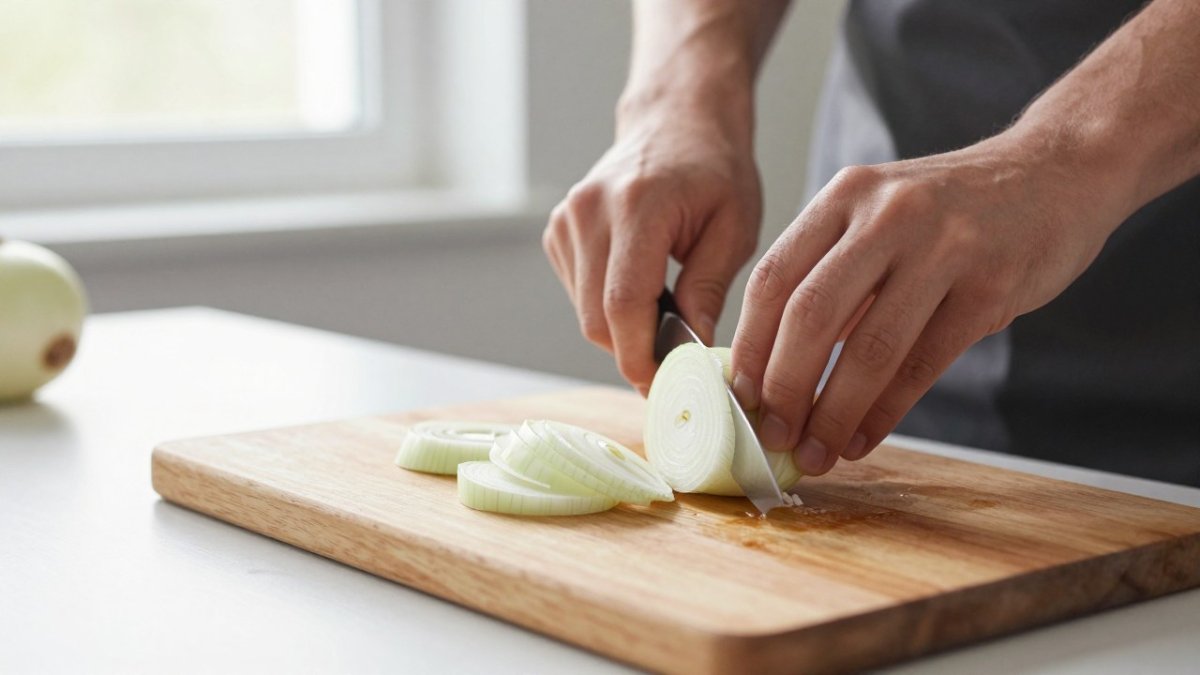
Good knife skills for home cooks come down to three things: a pinch grip, consistent cuts, and a sharp edge. Hold the blade between thumb and forefinger at the bolster, curl your guiding fingers into a claw, and let the knife do the work. Consistent cuts matter because uniform pieces cook at the same rate.
The Three Cuts That Cover Most Recipes
Most home recipes rely on a small vocabulary of cuts, and learning them in sequence builds control faster than trying to master everything at once.
- Slice: a single downward stroke with the blade moving forward slightly, used for onions, peppers, and proteins. Keep the tip on the board and lift only the heel.
- Dice: first cut the ingredient into sticks or planks of the target width, then cross-cut into cubes. A medium dice is roughly 1.5 cm; a small dice is roughly 1 cm. Uniformity matters more than exact size.
- Chiffonade: stack leafy herbs or greens, roll tightly, and slice crosswise into thin ribbons. This works for basil, mint, and leafy greens but not for woody herbs like rosemary.
Sharpening and Honing: What Each Actually Does
Honing realigns the edge; sharpening removes metal to create a new edge. They are not interchangeable, and confusing them is why many home knives stay dull.
- Hone before each session with a rod held vertically, blade at roughly a 20-degree angle, five to ten light strokes per side.
- Sharpen every few months with a whetstone or a pull-through sharpener, depending on the blade. A 1000-grit stone is a reasonable starting point for home maintenance.
- Test the edge by slicing a ripe tomato under its own weight. If the skin tears, the knife needs work.
Watch out: pull-through sharpeners remove more metal than stones and can shorten a blade's life if used weekly. Reserve them for inexpensive knives and use a stone or professional service for good blades.
Knife Care That Preserves the Edge
A sharp knife is safer than a dull one because it doesn't slip. Hand-wash and dry immediately rather than leaving it in the sink or dishwasher, where heat and detergent degrade the edge and handle.
A practical progression for a home cook is to spend two weeks practicing the claw and slice on onions and carrots, then move to dice on potatoes and peppers, then add chiffonade on herbs. Regular, deliberate practice tends to produce visible improvement over time.
Mise en Place for Home Cooks: Prep Like a Restaurant Line
Mise en place for home cooks means measuring, chopping, and organizing every ingredient before you turn on the heat. Professional kitchens run on it because it prevents burnt garlic, missing ingredients, and panic. Do the prep first, and cooking becomes calm.
- Read the entire recipe twice before starting
- Chop and measure everything into small bowls
- Pre-heat the oven and set out tools
If you're wondering how long this takes, our guide on how long private cooking classes at home run breaks down realistic timing for a full session.
How to Season Food Like a Chef
To season food like a chef, salt in layers throughout cooking rather than all at once at the end. Chefs taste constantly and adjust with salt, acid, and fat. A finished dish that tastes flat usually needs acid, not more salt.
Season proteins ahead so the salt penetrates. Taste at every stage. Finish with a squeeze of lemon or a splash of vinegar to brighten the whole plate.
Diagnosing and Fixing Common Cooking Failures
Most cooking failures are diagnosable, and each has a predictable fix. Pale meat means the pan wasn't hot enough or the surface was wet. Bitter garlic means it burned. Tough braises mean too little time or too high heat. Learn the symptom, and the correction becomes obvious.
| Symptom | Likely Cause | Fix |
|---|---|---|
| Pale, gray meat | Cold pan or wet surface | Pat dry, heat pan first |
| Bitter garlic | Burned at high heat | Add later, lower heat |
| Tough braise | Too hot, too short | Lower heat, extend time |
| Broken sauce | Fat added too fast | Whisk in cold liquid |
| Flat flavor | Missing acid | Finish with lemon or vinegar |
Food Safety and Kitchen Hygiene Every Cook Should Know
Food safety is the one area where home cooks should follow professional standards without compromise. Food safety is a core part of professional kitchen discipline: a chef's discipline around temperature and contamination is as much a part of the craft as knife work or sauce making.
Safe Temperatures Worth Memorizing
A digital instant-read thermometer is the single most useful food-safety tool in a home kitchen. The commonly cited safe internal temperatures are:
- Poultry (whole, parts, ground): 74 °C
- Ground meat (beef, pork, lamb): 71 °C
- Whole cuts of pork, beef, lamb, veal: 63 °C, rested at least three minutes
Insert the probe into the thickest part, avoiding bone and fat, which conduct heat differently. For poultry, check the thigh as well as the breast.
Cross-Contamination: The Chain to Break
Cross-contamination usually happens through three routes: hands, boards, and utensils. The fix is to assign tools by task and wash between transitions.
- Use a separate board for raw meat, poultry, and seafood, ideally color-coded or stored apart from the produce board.
- Wash hands with soap and warm water for at least 20 seconds after handling raw proteins, and dry with a clean towel rather than a shared one.
- Never place cooked food back on the board or plate that held it raw without washing first.
Watch out: wiping a board with a damp cloth and calling it clean is a common habit that spreads bacteria rather than removing it. Wash with hot soapy water, then sanitize.
Cooling, Storing, and Reheating
The danger zone is roughly 4 °C to 60 °C, and the goal is to move food through it quickly. Leaving stock or stew to cool on the counter overnight is a common habit and a real risk.
- Refrigerator: keep at or below 4 °C; use leftovers within three to four days.
- Freezer: keep at or below -18 °C; label with the date and use within the timeframe appropriate to the item.
- Reheating: bring leftovers to 74 °C and stir so heat distributes evenly.
A practical habit that mirrors professional kitchens is to label and date containers before they go into the fridge. It costs seconds and prevents the guessing game that leads to spoiled food or unnecessary waste.
Safe Internal Temperatures for Meat and Poultry
Book a Private Class and Practice With a Chef at Home
The fastest way to close the gap between home cooking and professional cooking is guided practice with someone who corrects you in the moment. That's exactly what we do at Mise en Your Place.
You can see the private cooking class experiences and menus we offer, or read exactly how a class works from first message to last bite before you commit. If you're comparing hands-on options, our guide on choosing a hands-on culinary experience for adults walks through what to look for. When you're ready, tell us about your group and preferred date and we'll handle the rest.
The real difference between a home cook and a professional isn't talent, it's repetition with feedback. Book a private class with Mise en Your Place and practice real techniques beside a chef, with all the mise en place handled and the kitchen left clean.
Frequently Asked Questions
How do I start learning to cook like a professional?
Start with the fundamentals rather than complicated recipes. Learn proper knife grip and safe cutting, set up mise en place before you turn on the heat, and practice one core cooking method at a time, such as searing or roasting. Read each recipe fully before starting so you understand the order of steps. Cooking at home consistently, even two or three times a week, builds the timing and heat control that professional cooks rely on.
What professional cooking techniques should every home cook learn first?
Focus on searing, sautéing, roasting, boiling, and braising, since most meals depend on them. Learn to control pan temperature, deglaze a pan to build a sauce, and reduce liquids for flavor. These professional cooking techniques matter more than any single recipe because they let you adapt to whatever ingredients you have. Practice each method with simple ingredients like chicken thighs or vegetables before moving to more complex dishes.
How can I improve my knife skills for home cooks without a professional class?
Use a sharp knife and a pinch grip, where your thumb and index finger hold the blade near the handle. Keep the tip of the knife on the board and rock it through the ingredient rather than chopping straight down. Curl the fingers of your guiding hand so your knuckles protect them. Practice on onions, carrots, and potatoes, and sharpen your knife regularly.
How long does it take to become a confident cook?
Confidence comes from repetition: searing the same cut of meat several times, tasting and adjusting seasoning as you go, and learning from mistakes.
Can you learn professional cooking techniques at home?
Yes. Professional cooking techniques do not require a restaurant kitchen, only good habits: sharp knives, a hot pan, prepped ingredients, and consistent seasoning. A home kitchen can handle searing, braising, roasting, and sauce work just as well as a commercial one. The main difference is organization and repetition. Working alongside a chef in your own kitchen lets you learn on the equipment you actually use every day.
What should I learn first when learning to cook?
Begin with knife skills and mise en place, because both make everything else easier and safer. Next, learn heat control on a single pan and practice tasting as you season. Once those feel natural, move to core methods like searing and roasting. Reading recipes fully before you start is also essential, since it prevents mistakes caused by missing a step or an ingredient.

Ready to cook something memorable?
Chef Chris brings the full restaurant experience into your home — every detail handled, every dish made together.