
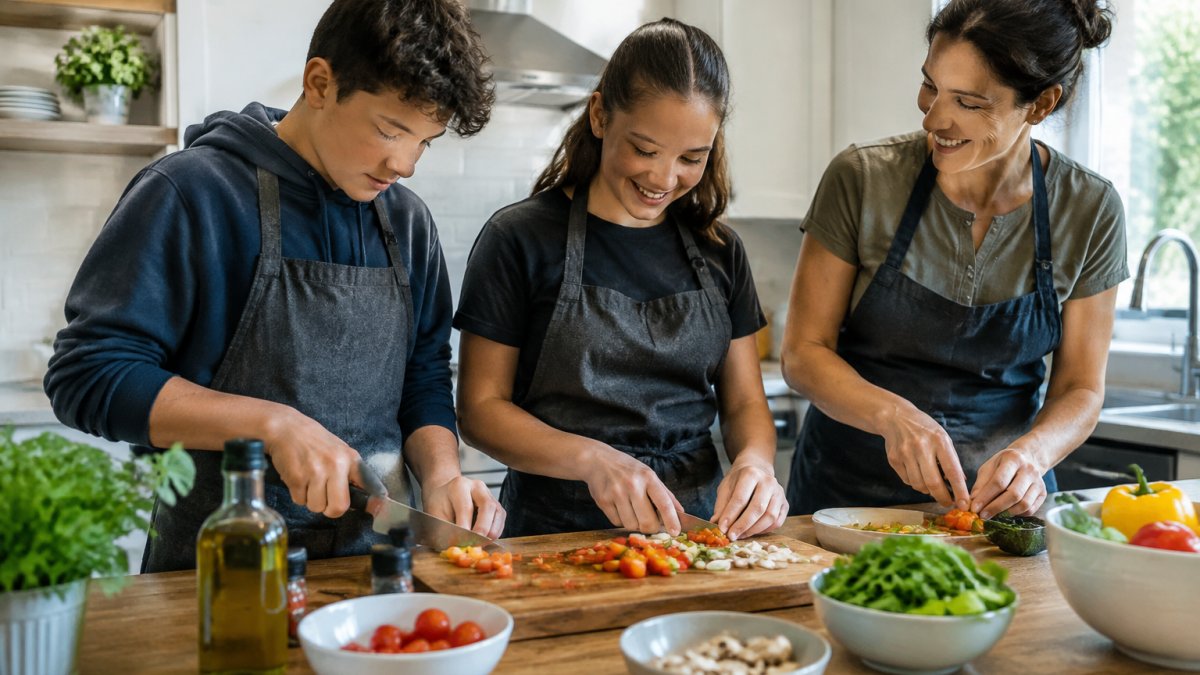
listicle
Are Family Cooking Activities Worth Trying With Teens?
Last Updated: November 12, 2026
Quick Summary
Family cooking activities give teens practical skills in timing, planning and following a process from start to finish. Starting with simple recipes, safety habits and knife basics helps teens build confidence and gradually take over the kitchen.
- Wash hands with soap for at least 20 seconds before handling food.
- Turn pot handles inward over the stove so they cannot be caught by an elbow.
- Use a food thermometer to check the thickest part of meat instead of guessing.
- Teach the claw grip and cut in one direction before moving to dicing.
- Plan five dinners in one 30-minute weekly session to reduce food waste.
Table of Contents
- Why Cooking Together Builds Real Life Skills in Teens
- Essential Kitchen Safety Tips for Teenagers Before Cooking Starts
- How to Teach Knife Skills to Teens Step by Step
- Family Cooking Activities for Teenagers Your Household Can Start This Week
- Building Culinary Skills for Teens Through Meal Planning and Budgeting
- Shifting Your Teen From Helper to Independent Cook
- Bringing a Chef Into Your Kitchen for a Guided Family Cooking Session
- Frequently Asked Questions
Why Cooking Together Builds Real Life Skills in Teens
Family cooking activities for teenagers do more than fill a weekend afternoon. Parents who want a structured plan can follow a step-by-step guide to cooking lessons for family bonding. Teens who cook with their families can learn timing, planning and how to follow a process from start to finish. Those are habits that matter long after the dishes are washed.
The appeal is simple. A shared kitchen gives teens a reason to work alongside a parent, and it gives parents a natural way to hand over responsibility a little at a time.
Cooking also builds the kind of confidence that spills into other areas. A teen who can produce a decent weeknight dinner feels more capable overall. That sense of competence is hard to fake, and it tends to grow with every meal.
Essential Kitchen Safety Tips for Teenagers Before Cooking Starts
Good kitchen habits come before good cooking, and the safety section is where most family guides stay vague. A teen who understands the why behind each rule is far more likely to follow it when no one is watching. Walk through these basics together before the first family cooking activity.
Setup and personal safety. Wash hands with soap for at least 20 seconds, tie back long hair, roll up loose sleeves, and remove dangling jewelry. Keep pot handles turned inward over the stove so they cannot be caught by an elbow.
Mise en place prevents most rushed errors. The habit of measuring and prepping every ingredient before the heat goes on is the single most effective safety mechanism in a home kitchen. Encourage teens to lay everything out first, then cook.
Food safety deserves its own rule set. Raw meat needs its own cutting board, and hands, knives and surfaces should be washed with hot soapy water after handling it. Never rinse raw poultry in the sink, because splashing spreads bacteria across the counter.
Use temperature, not guesswork. A food thermometer is the most underused tool in home kitchens. Poultry, ground meat, and leftovers all have different targets, and the Health Canada guidance linked above lists them (Safe cooking temperatures).
Cross-contamination is the invisible risk. Color-coded cutting boards, one for raw meat, one for produce, one for cooked food, make the rule easy to remember. Wash dishcloths and tea towels often, and replace sponges regularly, since both stay damp and harbor bacteria.
Stove and oven habits. Teach teens to turn pot handles inward, keep flammable items like paper towels and oven mitts away from burners, and never leave a pan of hot oil unattended. Show them how to smother a small pan fire with a lid rather than throwing water on it.
Knife safety belongs here too. A sharp knife is safer than a dull one, which slips and requires more force. Teach the claw grip early: fingertips curled under, knuckles guiding the blade, and the thumb tucked behind the fingers.
Watch out: the most common injury comes from reaching for a falling knife. Teach teens to step back and let it drop, then pick it up carefully by the handle.
The core safety habits covered in this section are easy to scan at a glance.
| Safety area | Key rule | Why it matters |
|---|---|---|
| Personal setup | Wash hands for at least 20 seconds | Removes germs before handling food |
| Pot handles | Turn handles inward over the stove | Stops elbows catching them |
| Raw meat | Use a separate cutting board | Prevents cross-contamination |
| Raw poultry | Never rinse it in the sink | Splashing spreads bacteria |
| Doneness | Check the thickest part with a thermometer | Replaces guesswork with a number |
| Falling knife | Step back and let it drop | Avoids reaching injuries |
| Pan fire | Smother with a lid, never water | Water can spread burning oil |
How to Teach Knife Skills to Teens Step by Step
Knife skills are the foundation of nearly every recipe, and they are the skill teens most often avoid. Start slowly. A complete beginner-level guide to cooking classes covers the basics for a teen starting from scratch. Show the claw grip first: fingertips curled under, knuckles guiding the blade, and the thumb tucked behind the fingers.
Work through the steps in order:
- Choose the right knife. A sharp chef's knife is safer than a dull one, which slips and requires more force.
- Practice the grip on a damp towel placed under the cutting board so it stays put.
- Cut in one direction, rocking the blade through a soft vegetable like a carrot.
- Move to dicing once slices are even and controlled.
- Increase speed only after accuracy holds. Clean, consistent cuts come first.
Watch out: the most common injury comes from reaching for a falling knife. Teach teens to step back and let it drop.
Family Cooking Activities for Teenagers Your Household Can Start This Week
The best family cooking activities are the ones that start small and feel like a project, not a chore. Pick one activity, assign roles, and let the teen take ownership. Families wanting ready-made experiences can browse the in-home cooking class options for a themed evening. For many households, that is the difference between a session that lasts and one that stalls after the first try.
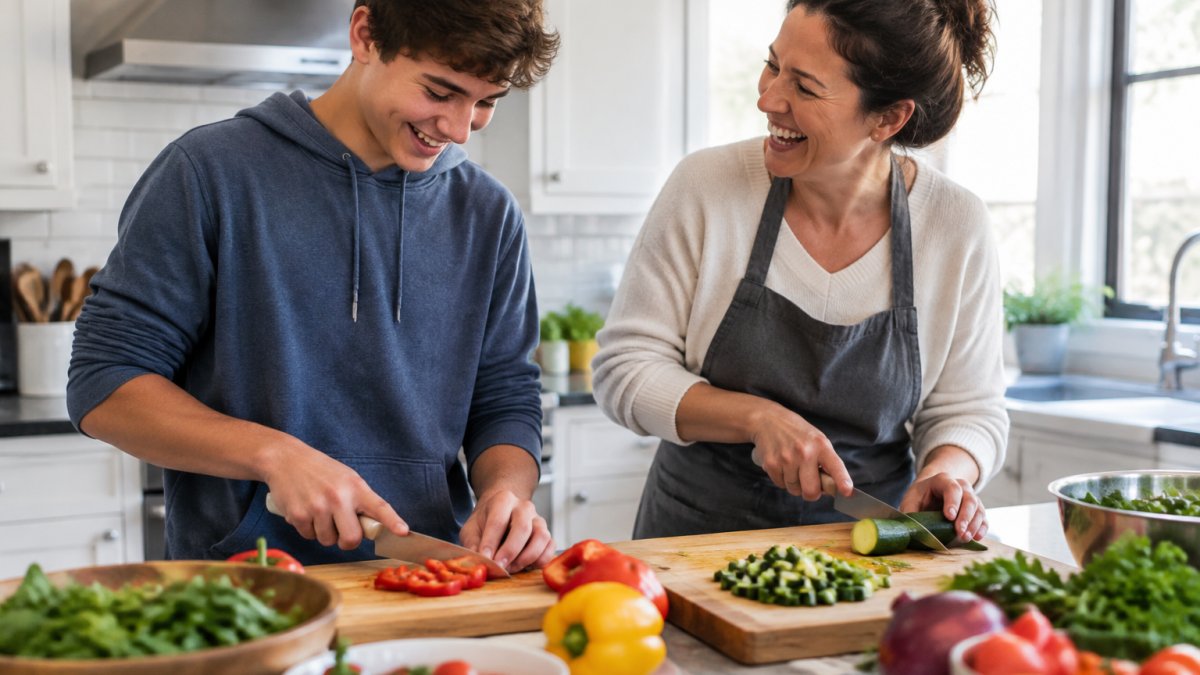
Easy Starter Recipes Teens Can Lead
Choose recipes with few steps and forgiving results. Sheet-pan dinners, stir-fries, homemade pizza and simple pasta sauces all work well. Let the teen read the recipe aloud, gather ingredients, and run the stove while a parent supervises from the counter. Stepping back as the teen gets comfortable is what builds real independence.
Family cooking activities for teenagers work best when the teen picks the menu. Ownership makes the effort feel like theirs.
Weekend Challenges and Cook-Off Ideas
Turn a meal into a friendly contest. Give everyone the same basket of ingredients and a 45-minute limit, then taste the results together. For guidance on running a fun interactive cooking party with friends, see how to host one. Themed challenges, such as a cuisine night or a dish built around one shared ingredient, keep things fresh. Pair the challenge with a guide to hosting an interactive cooking party if you want to bring in friends or extended family.
Watch out: competition can frustrate a teen who is still building skills. Keep the focus on learning, not winning.
Building Culinary Skills for Teens Through Meal Planning and Budgeting
Most family cooking guides stop at "involve your teen in meal planning." A practical life skill is cooking well on a student budget.
Start with a weekly planning ritual. Pick a fixed 30-minute slot, Sunday afternoon works for many households, and plan five dinners at once. Planning five dinners in one sitting can help a family buy ingredients that get used across multiple meals instead of letting half a bunch of celery wilt in the drawer.
Teach the three-part list. Have the teen write the list in three columns: pantry staples (oil, rice, pasta, canned tomatoes), fresh items that spoil (produce, dairy, meat), and one or two "flex" items for a treat or a new recipe. This structure makes it obvious where the money goes and which purchases need to be used first.
Build a price book. A simple notebook or phone note that records the regular price of the ten to fifteen items the household buys most often, eggs, milk, chicken, rice, pasta, canned beans, frozen vegetables, turns grocery shopping into a skill.
Cook once, eat twice. Teach the batch-and-remix method: cook a large pot of rice, a tray of roasted vegetables, and a protein on Sunday, then remix them into different meals through the week. A pot of chili becomes chili bowls, chili on baked potatoes, and chili-stuffed peppers.
Use the freezer deliberately. Label and date leftovers, freeze individual portions, and keep a running inventory taped to the freezer door. A teen who knows what is already in the freezer does not buy duplicates, and a household that eats its leftovers wastes less food and less money.
Give the teen a real budget to manage. Hand over a set amount for one dinner per week and let the teen plan, shop, and cook within it. The constraint is the lesson.
Use public data as a reference point. For families watching costs, the Statistics Canada food price data offers a useful reference for tracking how grocery prices change over time and for setting realistic expectations about what a weekly food budget looks like.
Connect planning to time management. Ask the teen to map out which dishes can be prepped on Sunday and which need last-minute attention. Those planning habits transfer directly to school projects and part-time work. A teen who can sequence a week of meals can sequence a week of deadlines.
Watch out: a budget that is too tight to allow any flexibility tends to collapse by Wednesday. Build in a small buffer for a treat or a takeout night, or the plan will not survive contact with a busy week.
Shifting Your Teen From Helper to Independent Cook
The goal is a teen who can cook a complete meal without a parent in the room. Make the transition gradual. Start with a parent in the kitchen, move to a parent nearby, then to a teen cooking alone with a check-in at the end.
Set clear milestones: cooking one meal per week solo, planning and shopping for a dinner, and cleaning the workspace afterwards. Many families find that giving a teen a regular night of their own creates steady progress.
A simple rule is that the teen should be able to explain each step of a recipe before they start it.
Bringing a Chef Into Your Kitchen for a Guided Family Cooking Session
Some families want structured guidance from a professional. A private, chef-led session can give teens focused instruction in technique while the family cooks and eats together. With a private chef-led session, the chef handles the mise en place and cleanup, so the family can concentrate on learning. To plan your perfect evening, tell us about your group, preferred date, and what you'd like to cook.
Pricing depends on group size, dates and the menu chosen, so visit the [PAGE_LINK: plan your private cooking evening | Mise en Your Place contact page] for a quote tailored to your household.
Frequently Asked Questions
How can I get my teenager interested in cooking?
Start with food they already like and let them choose the recipe. Teens respond better to ownership than instruction, so giving them a real role, such as planning a family dinner or hosting a weekend cook-off, builds interest faster than asking them to help. Keep the first sessions short and low-pressure, and praise effort over perfection. Once they feel capable, most teens start wanting to try harder recipes on their own.
What are some easy cooking skills for teenagers to learn first?
Good starting skills include measuring accurately, following a recipe from start to finish, safe knife handling, sautéing vegetables, and basic temperature control with a stovetop. Baking basics such as making muffins or a simple sheet-pan dinner also teach timing and food handling. Culinary skills for teens build fastest when each new technique is practised in a recipe they actually want to eat.
How do you make cooking a fun family activity?
Turn cooking into a shared event with a theme night, a rotating chef role, or a simple challenge such as making a meal with five ingredients from the fridge. Put on music, let each person own one dish, and eat together at the end. A relaxed kitchen with clear roles and a clean-as-you-go rule keeps the activity enjoyable instead of stressful for everyone involved.
What are the benefits of teaching teenagers to cook?
Teaching teens to cook builds independence, nutritional literacy, and time management, and it gives them a practical skill they will use for life. Teens who cook regularly tend to develop healthy eating habits and a better sense of budgeting when they plan meals and shop. Cooking together also creates regular, low-pressure time for conversation between parents and teens.

Ready to cook something memorable?
Chef Chris brings the full restaurant experience into your home — every detail handled, every dish made together.