
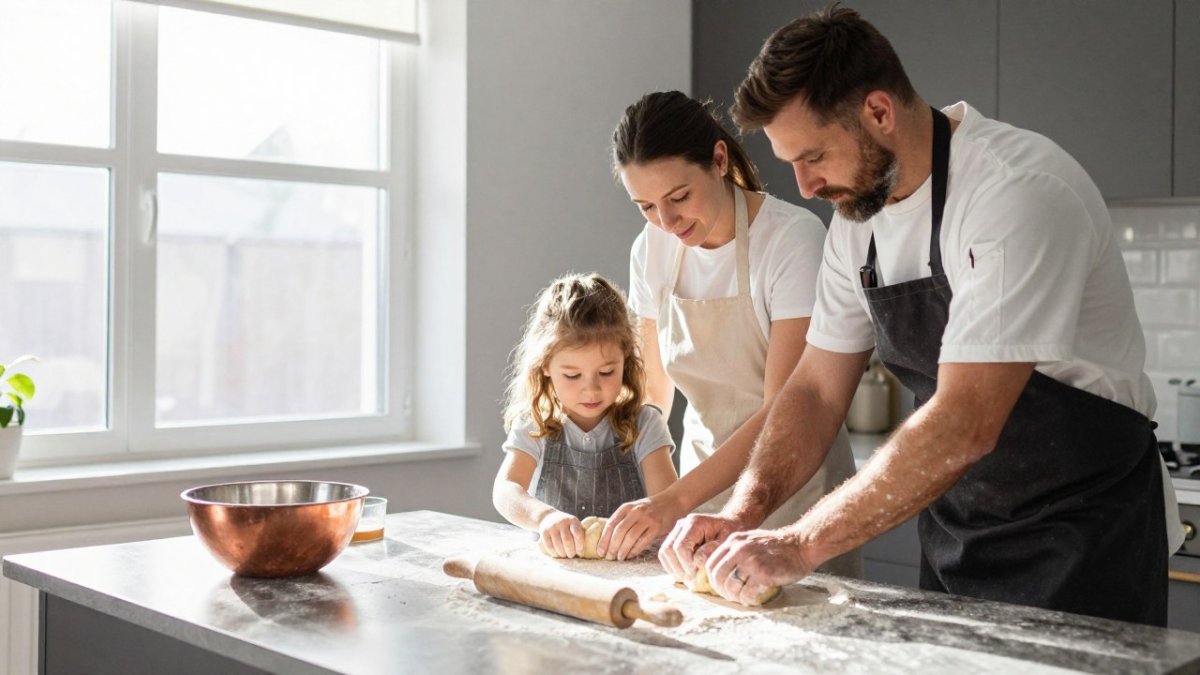
how-to
Team Building Through Family Cooking at Home
Quick Summary
Team building through family cooking works by giving each person a real job, a visible result and a reason to talk. Assign roles by capability, let everyone make one decision, and keep the first meal simple with a shared target.
- Give each person a real job with a visible effect on the final dish.
- Assign tasks by capability, not age, and offer a seated version of each task.
- Let every participant make one owned decision, such as choosing a topping or spice.
- Plan about 60 to 90 minutes for a shared meal, including cleanup.
- Settle allergies and dietary needs before shopping and prepare the safe portion first.
Table of Contents
- Communication and collaboration in the kitchen
- Family Cooking Activities That Build Teamwork
- Easy Meals to Cook Together, Without the Stress
- Family Cooking Challenge Ideas for Friendly Competition
- Dividing Roles and Tasks Fairly in the Kitchen
- How Long a Family Cooking Activity Should Take
- Planning Your First Family Cooking Night
- Frequently Asked Questions
Why Family Cooking Works as Team Building
Most families eat together, but few cook together with a shared goal. Cooking as a group gives each person a real job, a visible result and a reason to talk. A step-by-step guide to cooking lessons for family bonding walks through how to set this up at home. Used deliberately, it becomes a practical form of team building for the household.
Mise en Your Place, led by Chef Chris Hrynyk, offers private, hands-on cooking classes. The principles below can be applied at home without a chef.
Canadian Paediatric Society guidance on family meals and child development
Communication and collaboration in the kitchen
A kitchen project forces small, frequent exchanges. Someone asks for the salt, someone else checks the timer, and a child reports that the onions are done. Each request is a tiny practice in clear communication.
Families that cook together tend to develop a shorter shorthand over time. A common mistake is letting one adult direct everything. Hand out clear roles and let the group call out problems as they happen.
Problem-solving and shared decisions
Recipes rarely go exactly to plan. The sauce splits, the bread is dense, or the dinner is ready twenty minutes late. These moments are useful, because the family has to decide together what to do next.
Ask open questions instead of giving answers. "What could we add to fix the flavour?" invites more ideas than "Add more salt." Over time, children learn that a mistake is a problem to solve, not a failure to hide.
Family Cooking Activities That Build Teamwork
Choose activities where everyone has a visible part. Our article on whether family cooking activities suit teens looks at how these formats work for older children. Family cooking activities work best when each person can see how their work changes the final dish, and when the task design accounts for the fact that a family group usually spans several ages, attention spans and skill levels at once.
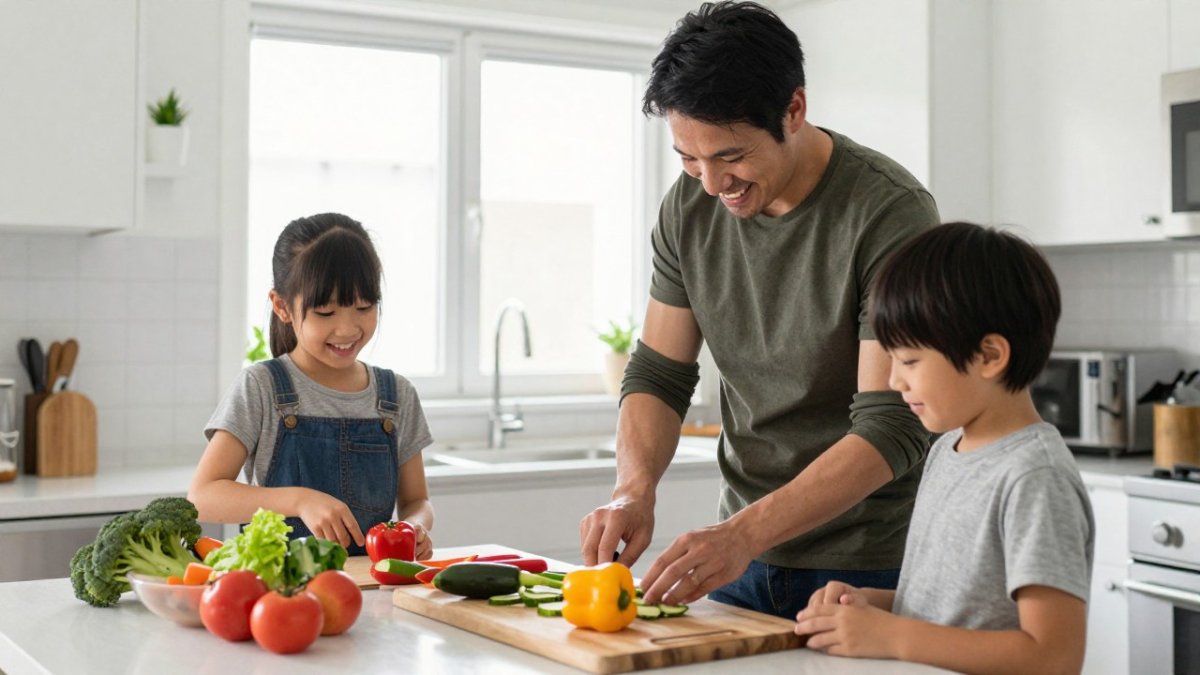
A parent and two children in a bright Canadian home kitchen, each holding a task on a shared dinner prep, laughing over a cutting board of vegetables.
Good options include building a homemade pizza with each person choosing toppings, assembling tacos from a prep line, or making a stir-fry where one person chops, one manages the pan and one sets the table. Each activity gives the group a shared finish line. To make those formats work across ages and abilities, build in these adaptations:
- Assign by capability, not by age. A younger child can tear herbs, rinse produce, count ingredients or press dough; an older child or teen can measure, chop soft vegetables with a table knife, or run the timer; an adult handles the stove, raw meat and anything sharp. Offer a seated version of every task (a stool at the counter, a tray at the table) so a family member with limited mobility can still hold a real job.
- Give every person one decision. Let each participant choose a topping, a spice, a side or the order of steps. Shared decision-making is the mechanism that turns cooking into teamwork, and a single owned choice per person is enough to create it without turning dinner into a debate.
- Use a visible shared target. A written order board, a plated reference photo or a simple checklist on the fridge lets the group self-correct instead of waiting for an adult to direct.
- Build in a swap. Rotate one role halfway through so nobody is stuck on dishes or chopping for the whole session, and so each person practices communicating about a task they did not start.
For a friendly-competition version, split into two teams and have each build the same simple dish, then score on taste, presentation and how well the team communicated rather than on speed alone. A pantry challenge, where each team must use only what is already in the fridge, works well for mixed ages because the constraint matters more than knife skills.
Cultural food traditions are one of the richest and least-used activity sources. A dumpling-folding session, a build-your-own taco or wrap line, a flatbread-topping station or a family recipe passed down from a grandparent gives every generation something to contribute and gives children a reason to ask questions. Ask each family member to nominate one dish from their own background, then pick two or three that can be prepped in parallel.
The article lays out a few practical adaptations for mixed-age family cooking. Here is a quick reference.
| Adaptation | What it means | Example |
|---|---|---|
| Assign by capability | Match tasks to skill, not age | Younger child tears herbs; adult handles the stove |
| Give every person one decision | Each member owns one choice | Pick a topping, spice or side |
| Use a visible shared target | Keep a reference the group can see | Order board, plated photo or fridge checklist |
| Build in a swap | Rotate one role mid-session | Switch chopping and cleanup halfway through |
Easy Meals to Cook Together, Without the Stress
Keep the first few sessions simple. A beginner-focused guide to cooking classes covers the basics of getting started with no prior experience. Meals with few steps and forgiving timing let the family focus on working together rather than on a complicated recipe. The goal of the first session is a finished shared dish and a good conversation, not a perfect plate.
Sheet-pan dinners, soft tacos and baked pasta are good starting points. Choose one recipe that the whole group can finish in about an hour, and favor dishes that tolerate a late start or a slow chopper: sheet-pan vegetables and protein, a one-pot pasta, a build-your-own wrap or taco line, or a stir-fry with prepped ingredients laid out before anyone turns on the heat. Pantry-based recipes (rice and beans, frittata, pancakes, soup from frozen vegetables) keep the cost low and remove the pressure of a specialty shopping trip.
Dietary needs and food allergies have to be settled before the shopping list is written, not during prep. A workable routine:
- Collect needs in advance. Ask every participant, including guests and visiting grandparents, about allergies, intolerances, religious restrictions and strong preferences, and write the answers on one sheet that stays on the fridge.
- Read every label at the store. Check ingredient lists for the allergens flagged, and remember that sauces, stocks, bouillon and spice blends are common hidden sources.
- Prevent cross-contamination during prep. Use separate cutting boards and utensils for raw meat and for allergen-free portions, keep the allergen-containing ingredient in a closed container, and designate one person to handle it so hands do not travel between stations.
- Offer a safe parallel portion. Build the allergen-free version first, set it aside covered, then add the allergen to the main dish. This is simpler than trying to remove an ingredient later.
Kitchen safety follows the same logic: match tools to ability (table knives and kitchen shears for younger children, a stable stool or seated station for anyone who needs it), keep handles turned inward, supervise the stove and oven closely, and assign one adult as the safety lead for the session. Health Canada's safe food handling guidance is a useful reference for washing, chilling and storing leftovers.
Watch out: a dish that looks allergy-safe can still be contaminated by a shared spoon or a cutting board used for the allergen version, so build the safe portion first and keep it covered until serving.
Health Canada guidance on safe food handling at home
Family Cooking Challenge Ideas for Friendly Competition
Light competition can add energy, as long as nobody is left feeling judged. Try a timed challenge where two teams build the same simple dish, or a "pantry challenge" where everyone must use what is already in the fridge.
Score the results on taste, presentation and teamwork rather than only on speed. That keeps younger family members engaged and prevents one person from dominating.
Dividing Roles and Tasks Fairly in the Kitchen
Assign roles before anyone touches a knife. A simple rotation works well: one person handles measuring, one handles chopping, one handles the stove and one handles cleanup. Swap roles each session so everyone learns several skills.
Match tasks to age and ability. Younger children can wash vegetables, stir and set the table. Teenagers can take on a full dish. Check in midway to make sure the workload still feels balanced.
How Long a Family Cooking Activity Should Take
Plan for about 60 to 90 minutes for a shared meal, including cleanup. That window is long enough to build something together and short enough to fit a busy weeknight. A weekend cooking session can stretch longer if the family enjoys it.
Keep a rough timeline on the fridge so everyone knows when to move to the next step. Short, clearly marked stages make the activity feel manageable.
Planning Your First Family Cooking Night
Start by choosing one dish, one date and a clear budget. Shop together if you can, and let each person pick one ingredient. Clean as you go, and keep a list of what worked for the next session.
Families who want a guided start can book a private, chef-led session with Mise en Your Place. Tell us about your group and preferred date and we will take it from there. The chef handles the mise en place and cleanup, so the family can focus on learning and cooking together. For current pricing, visit the Mise en Your Place website or request a quote.
Health Canada guidance on safe food handling at home
Frequently Asked Questions
How does cooking together build teamwork?
Cooking together requires people to share tasks, communicate timing, and adjust when something goes wrong, such as a sauce that needs more time. Each person learns to rely on others and to speak up when something needs attention. Families often find these small moments of coordination carry over to homework, chores, and conflict resolution. The kitchen gives everyone a concrete goal, which makes collaboration feel natural rather than forced.
How long should a family cooking team-building activity take?
Most family cooking activities work well in 60 to 90 minutes, which covers planning, prep, cooking, and eating together. Younger children tend to lose focus after about 45 minutes of hands-on work, so shorter recipes or a split-up prep stage can help. Plan extra time for cleanup, since that is often where families lose momentum. A relaxed pace matters more than a strict schedule.
How can families divide cooking tasks fairly?
Assign roles based on age and confidence, not just who is available. A young child can wash vegetables and stir, an older teen can measure and chop, and an adult can handle heat and knives. Rotate roles across sessions so everyone practises different skills. Let each person choose one task they want to try, which helps people feel invested in the result.

Ready to cook something memorable?
Chef Chris brings the full restaurant experience into your home — every detail handled, every dish made together.